Pearson Edexcel · GCSE · Psychology
Course version: 1PS0 · Version from Sept 2017
Understand the use of trait theory as a measure of personality, including…
Full specification wording
The self: 7.1.6 Understand the use of trait theory as a measure of personality, including strengths and weaknesses of trait theory: a. Allport (1936) cardinal, central and secondary personality traits b. Cattell (1946) 16PF personality factor assessment
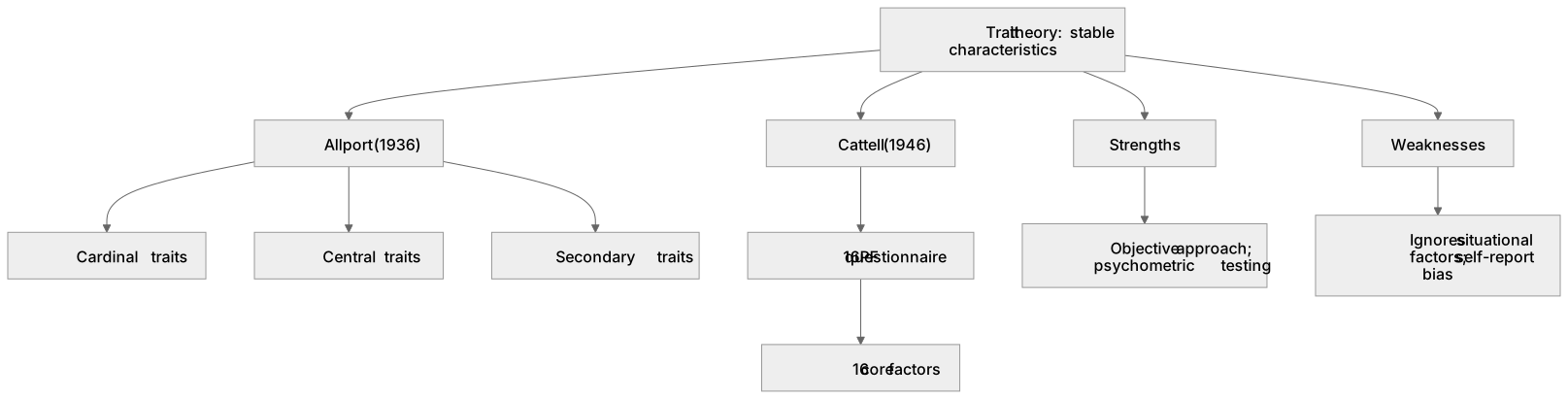
Trait theory measures personality by identifying stable characteristics that influence behaviour.
Checked against the Pearson Edexcel 1PS0 specification (opens in a new tab) on .
- Point 6 of 6
- 4 key terms
Study notes
From the checked teaching notes for this specification point.
The idea
Trait theory measures personality by identifying stable characteristics that influence behaviour. Allport (1936) categorised traits into three levels: cardinal traits (rare, dominant traits defining a person's whole life), central traits (general characteristics forming the personality foundation), and secondary traits (preferences appearing only in specific situations). Cattell (1946) reduced thousands of traits to 16 core factors, developing the 16PF questionnaire to assess them quantitatively. Strengths include its objective approach and practical application in psychometric testing. Weaknesses include failing to account for situational factors and relying on self-report methods, which risk bias.
What earns the marks
- Identify Allport's three trait levels: cardinal, central, and secondary.
- Describe Cattell's 16PF as a quantitative assessment of 16 core personality factors.
- Evaluate trait theory by explaining a strength, such as its objective measurement or practical use in testing.
- Evaluate trait theory by explaining a weakness, such as ignoring situational influences on behaviour or relying on self-report questionnaires.
Common mistakes and how to put them right
Confusing cardinal and central traits.
Put it right: Cardinal traits are rare and dominate a person's entire life, whereas central traits are common building blocks of personality.
Assuming Cattell identified 16 traits in total.
Put it right: Cattell identified 16 underlying personality factors that form the basis of all surface traits.
Stating trait theory explains how personality develops.
Put it right: Trait theory focuses on measuring and describing personality traits, not explaining their origins or development.
Exam tips
- Use specific examples to distinguish between Allport's trait levels, such as 'Machiavellian' for a cardinal trait.
- When evaluating trait theory, link the reliance on self-report questionnaires to the risk of social desirability bias.
- Remember that Cattell used factor analysis to narrow down Allport's extensive list of traits to his 16 personality factors.
Try the lesson
The start of the The self: 7.1.6 Understand the use of trait theory as a measure of personality, including strengths and weaknesses of trait theory: a. Allport (1936) cardinal, central and secondary personality traits b. Cattell (1946) 16PF personality factor assessment lesson, made from checked teaching notes for this specification point.
Have a go first
According to Allport (1936), which type of personality trait dominates an individual's entire life and shapes most of their behaviour?
Listen
Trait theory measures personality by identifying stable characteristics that influence behaviour. Allport (1936) categorised traits into three levels: cardinal traits (rare, dominant traits defining a person's whole life), central traits (general characteristics forming the personality foundation), and secondary traits (preferences appearing only in specific situations). Cattell (1946) reduced thousands of traits to 16 core factors, developing the 16PF questionnaire to assess them quantitatively. Strengths include its objective approach and practical application in psychometric testing. Weaknesses include failing to account for situational factors and relying on self-report methods, which risk bias. A strong answer earns marks for these points. Identify Allport's three trait levels: cardinal, central, and secondary. Describe Cattell's 16PF as a quantitative assessment of 16 core personality factors. Evaluate trait theory by explaining a strength, such as its objective measurement or practical use in testing. Evaluate trait theory by explaining a weakness, such as ignoring situational influences on behaviour or relying on self-report questionnaires. Exam tip: Use specific examples to distinguish between Allport's trait levels, such as 'Machiavellian' for a cardinal trait.
See it
Key words
Say what each word means before you turn the card.
Cardinal traits
Try answering aloud or in your head before turning the card.
Central traits
Try answering aloud or in your head before turning the card.
Secondary traits
Try answering aloud or in your head before turning the card.
16PF
Try answering aloud or in your head before turning the card.
See every definition
- Cardinal traits
- Rare, dominant traits defining a person's whole life, as categorised by Allport (1936).
- Central traits
- General characteristics forming the personality foundation, as categorised by Allport (1936).
- Secondary traits
- Preferences appearing only in specific situations, as categorised by Allport (1936).
- 16PF
- A questionnaire developed by Cattell (1946) to assess 16 core personality factors quantitatively.
Label the diagram
Some boxes have lost their names. Pick the right name for each number.
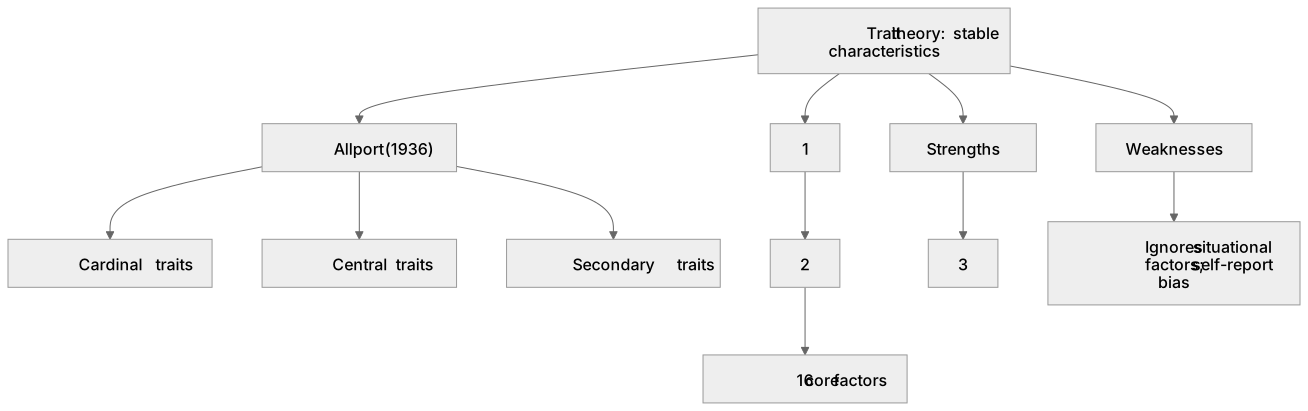
1Box 1
2Box 2
3Box 3
There is more to this lesson
The full lesson goes on to check your understanding and help you earn the marks. Create a free account to carry on, with your progress saved.
A week of Premium from your first lesson · Then the free plan continues · No card, no charge
Test your understanding of The self: 7.1.6 Understand the use of trait theory as a measure of personality, including strengths and weaknesses of trait theory: a. Allport (1936) cardinal, central and secondary personality traits b. Cattell (1946) 16PF personality factor assessment
Active recall beats re-reading. Take an instant quiz now to test what you’ve learned and lock it into long-term memory.
A week of Premium from your first lesson · Then the free plan continues · No card, no charge